
Beyond Wall Street: Why True Diversification Requires More Than International Stocks
The extraordinary success of U.S. markets has rewarded generations of American investors. But as portfolios become increasingly concentrated in a handful of companies, understanding the difference between owning many investments and having genuinely diversified wealth becomes more important.
For decades, American investors have had compelling reasons to keep their money close to home. The United States offers deep capital markets, world-leading companies and an exceptional record of innovation. Investors who maintained substantial exposure to U.S. equities, particularly large technology companies, have benefited enormously.
Yet past success creates an important question: When does a successful investment preference become an excessive dependency?
In a recent episode of Swiss Money Secrets, we explored this question with Ryan Ahrens, Chief Investment Officer at Green Ocean Global Advisors. Our discussion focused on how American investors can balance U.S. and European exposure—and why meaningful diversification extends beyond the securities in a brokerage account.
Home Bias: Rational, but Not Risk-Free
Home bias describes investors' tendency to favor domestic investments over foreign alternatives.
For Americans, this preference is understandable. Domestic companies are familiar, financial information is readily available, and U.S. investments often align naturally with dollar-denominated expenses and liabilities.
The difficulty arises when familiarity is confused with diversification.
An investor holding 100 different securities may appear well diversified. But if those holdings are predominantly American companies exposed to similar economic conditions, interest rates and market sentiment, the underlying portfolio may be less diversified than the number of positions suggests.
The objective should not be to eliminate home bias. It should be to understand its consequences.
The Concentration Hidden Inside U.S. Equities
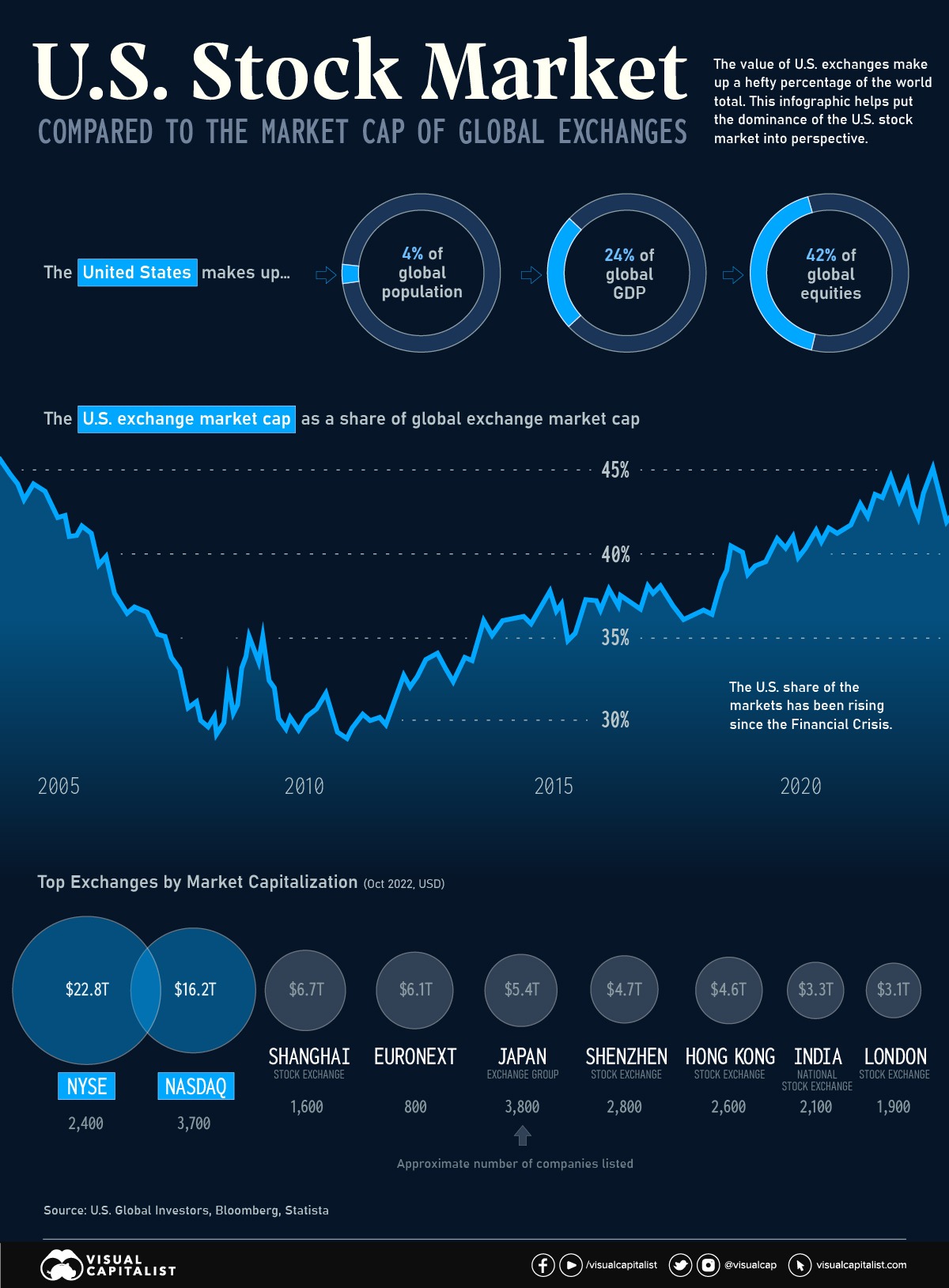
The American stock market represents a substantial share of global equity value. According to MSCI's global equity indices, U.S. companies account for roughly two-thirds of developed-market equity capitalization, although their share of the broader global market, including emerging economies, is lower.
This dominance creates an interesting challenge for passive investors.
By mid-2026, the ten largest companies in the S&P 500 represented close to 40% of the index's market capitalization. Consequently, an investor purchasing an S&P 500 index fund owns approximately 500 companies but has a substantial portion of the investment concentrated in a relatively small group of businesses.
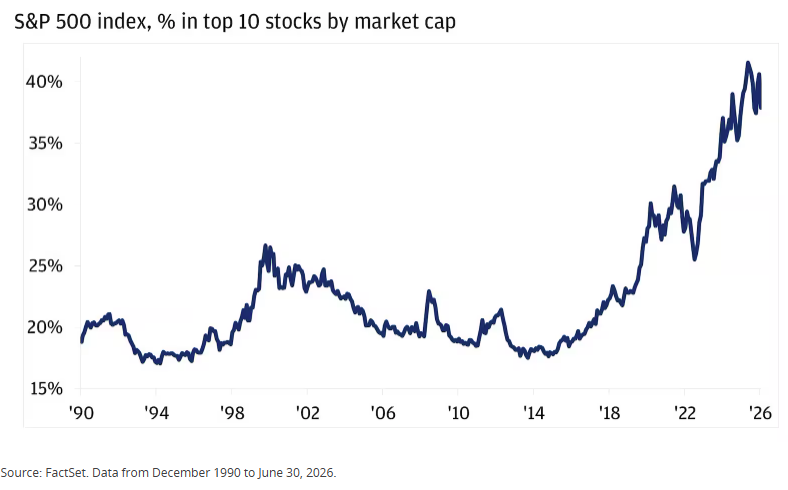
These companies may continue to deliver excellent returns. Their size alone does not make them unattractive investments. However, concentration increases sensitivity to their earnings expectations, valuations and business prospects.
International markets offer different sector compositions and economic exposures. European equities, for example, provide greater representation in certain industrial, financial, healthcare and consumer sectors.
Diversifying internationally therefore offers more than additional company names. It can change the fundamental sources of portfolio risk and return.
According to the MSCI All Country World Index, U.S. equities represented approximately 65% of global large- and mid-cap equity capitalization in October 2026. That leaves roughly 35% outside the United States—an opportunity set too significant to ignore.
Your Currency Exposure Matters More Than Your Account Currency
International investing introduces another dimension: currency.
An American investor might own European equities through a U.S.-listed fund denominated in dollars. Yet the dollar denomination does not eliminate the underlying foreign-currency exposure. Similarly, holding an investment in a Swiss bank does not automatically create Swiss-franc exposure.
The relevant considerations are the underlying assets, their economic sensitivities, any currency hedging and the investor's future spending needs.
For someone expecting to retire in Portugal or Switzerland, maintaining all financial assets in dollars creates a potential mismatch between wealth and future expenses.
The dollar remains the world's dominant reserve currency, but its position is evolving. According to the International Monetary Fund, the dollar accounted for 56.7% of global foreign-exchange reserves in the second quarter of 2026, compared with 57.18% in the preceding quarter.
This is not evidence of an imminent collapse of the dollar. It does, however, reinforce the importance of considering long-term currency risk without relying on predictions about the future monetary system.
Jurisdictional Diversification: A Separate Decision
There is a third dimension often overlooked in portfolio discussions: where assets are legally held and administered.
Investment diversification concerns what an investor owns. Currency diversification concerns exposure to exchange-rate movements. Jurisdictional diversification concerns the legal, regulatory and institutional environments in which assets are custodied.
These distinctions matter. An American can own Swiss equities through a U.S. custodian, hold U.S. Treasury bonds at a Swiss bank, or maintain assets across multiple banking jurisdictions.
Each arrangement creates different operational, legal and counterparty considerations.
Holding assets abroad does not eliminate market risk, U.S. reporting obligations or exposure to financial institutions. Nor is a foreign custodian automatically safer than an American one.
However, jurisdictional diversification may reduce dependence on a single financial infrastructure, provided the additional complexity, costs and regulatory obligations are justified.
Build a Strategy Around Your Life, Not an Index
Effective diversification begins with an assessment of total wealth.
An American investor may already have substantial domestic exposure through employment income, real estate, retirement accounts, Social Security and investment portfolios. These assets should be considered collectively rather than in isolation.
The appropriate international allocation will depend on investment objectives, time horizon, risk tolerance and anticipated spending currencies.
There are trade-offs. Foreign markets can underperform the United States for extended periods. Currency fluctuations can amplify losses, and international custody can introduce additional costs and administrative requirements.
The goal is not to abandon America's investment success story. It is to ensure that financial security does not depend entirely on its continuation.
For investors building wealth across generations, that distinction may prove more important than predicting which market performs best next year.