
Equanimity Instead of Excitement
As we turn the page on the past year, I find myself both grateful and reflective. It has been an intense year for investors—one filled with headlines, uncertainty, and emotional swings that tested even the most disciplined among us. Yet, despite the noise, a great deal went right. For many of our clients, the conscious decision to reduce an overreliance on the U.S. dollar and to diversify internationally proved more valuable than it has in a long time.
Bloomberg summed it up well when it wrote: “Dollar Posts Worst Year Since 2017 With More Fed Cuts Expected.” This development did not come as a surprise to us. Our focus on creating a counterweight to U.S. dollar exposure, combined with our long-term allocation to precious metals, contributed meaningfully to portfolio resilience and performance. While gold once again stood in the spotlight, other metals required patience and conviction—qualities that are often underestimated but rarely unrewarded.
In times like these, the biggest challenge for investors is not a lack of opportunity, but the temptation to become overly excited. And excitement, as experience shows us again and again, is rarely a good guide.
Excitement Is the Investor’s Enemy
If we look back to 2021, the lesson is clear. Many who got swept up in the excitement around GameStop paid a heavy price for letting emotions override discipline. Nvidia, on the other hand, ultimately turned out to be a remarkable long-term investment—but even there, the path was anything but smooth. An investor who bought Nvidia at its peak in 2021 around USD 33 per share had to endure a painful drawdown of roughly 66% when the stock fell to about USD 11 in October 2022.
The reason I bring this up is simple: sustainable value is built over time, not overnight. Even when success comes quickly, it should never blind us. If you follow the wealthiest investors and entrepreneurs in the world, you will notice a consistent pattern. In 2025 alone, billionaires such as Jeff Bezos, Michael Dell, Jensen Huang, and Mark Zuckerberg sold billions worth of their own shares (Jeff Bezos, Michael Dell Led Billionaire Insider Selling in 2025 - Bloomberg). This is rarely a lack of confidence in their businesses. It is, instead, a deep understanding of diversification and wealth preservation across generations.
This mindset is particularly relevant as we look ahead to 2026.
Looking Ahead: Why Markets May Stay Supported
Following our previous Swiss View, the likelihood remains that markets will continue to be supported—at least in the near term. One important reason is political. With U.S. midterm elections approaching, history shows that governments often have an incentive to keep financial markets buoyant. As I already mentioned back in November, the tools to do so are available and have been used repeatedly in similar phases of the cycle.
We have seen global equity indices close 2025 at new all-time highs and extend those gains into the new year. There is growing speculation that President Trump may continue to roll back tariffs, while the expected change in leadership at the Federal Reserve is fueling hopes for further interest rate cuts and a renewed expansion of quantitative easing. This combination has, time and again, proven to be supportive for equity markets.
From a European perspective, an additional source of support is emerging from increased demand by U.S. residents relocating to what they perceive as a more reliable and stable Europe. These moves are often accompanied by a partial relocation of wealth, as individuals seek to diversify away from the U.S. dollar and protect themselves against its ongoing devaluation. Such capital flows have the potential to provide incremental support to European markets.
China also appears increasingly motivated to stimulate its economy and reopen more decisively. After a strong start to the new year, the AI boom in China is gaining momentum, and there is a high likelihood that it will be actively supported by the Chinese government in an effort to restore growth and confidence. Maintaining economic expansion has become more challenging in recent years, and even when official growth targets are met, doubts about the reliability of the data have grown. This backdrop increases the incentive for policymakers to act forcefully.
That said, strong markets do not automatically equate to low risk—which brings me to a topic that deserves continued attention.
Who Still Believes in the “USDelulu”?
For those unfamiliar with the term, “delulu” is popular slang among younger generations and describes a state of unrealistic or delusional confidence. In 2025, the U.S. dollar provided a textbook example.
The U.S. Dollar Index (DXY) fell by roughly 10% over the year, marking its worst performance since 2017. There were very few currencies that did not appreciate against the dollar. While short-term rebounds are always possible the broader picture remains unchanged. In the medium to long term, we do not see a convincing scenario in which the U.S. dollar regains significant strength (USD Forecast 2025: Will the US Dollar Rise Again or Keep Falling?).
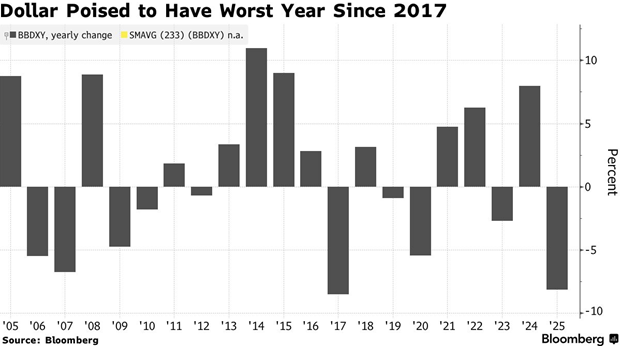
Options markets are signaling continued dollar weakness in the months ahead, and the announcement of Jerome Powell’s successor as Fed Chair will be another decisive factor. For investors, this reinforces the importance of holding assets outside the U.S. dollar—particularly in strong, independent currencies such as the Swiss franc.
| 2025-03-01 | 2026-02-01 | Performance |
DXY | 109.394 | 98.453 | -10.00% |
USD/EUR | 0.9742 | 0.8532 | -12.42% |
USD/CHF | 0.9123 | 0.7932 | -13.05% |
USD/GBP | 0.8078 | 0.7442 | -7.87% |
USD/JPY | 157.5 | 156.98 | -0.33% |
USD/CAD | 1.4403 | 1.3728 | -4.69% |
USD/AUD | 1.612 | 1.4938 | -7.33% |
USD/MXN | 20.6043 | 17.9419 | -12.92% |
USD/NOK | 11.395 | 10.0796 | -11.54% |
USD/SEK | 11.1102 | 9.2137 | -17.07% |
USD/DKK | 7.2662 | 6.3608 | -12.46% |
USD/RUB | 114.6616 | 80.0312 | -30.20% |
USD/CNY | 7.2994 | 6.989 | -4.25% |
Based on Data from Bloomberg | |||
Fixed Income: What Income, Exactly?
As interest rates move lower, so does the income generated by bonds. This shifts the focus in fixed income investing away from income and toward price movements. We have seen in the past that bonds can trade far above par value when rates fall—sometimes well beyond 100% of face value. A striking example is the 50-year Swiss government bond, issues in 2014, which traded above 230% of par in 2020 while paying a modest annual coupon of 2%.
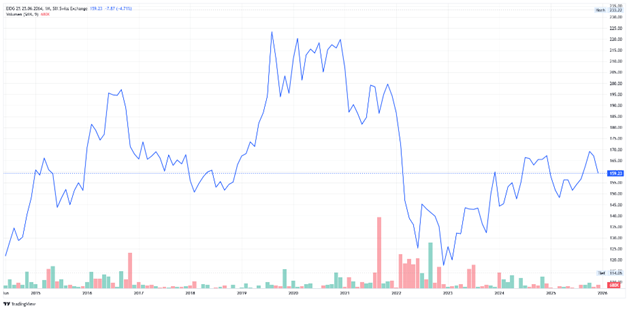
In an environment of rising inflation, fixed income markets suffered sharp losses in 2022 alongside equities. Therefore, reigniting inflation caused through lower interest rates, higher stimulus measures, and a rising M2 figure, the expected protection of the bond market can become limited (Stock-bond return correlation: Understanding the changing behaviour). That said, volatility should not be confused with safety. For long-term investors who value priority in the capital structure in the event of bankruptcy, fixed income can still play a role—provided the yield compensates adequately for inflation and risk.
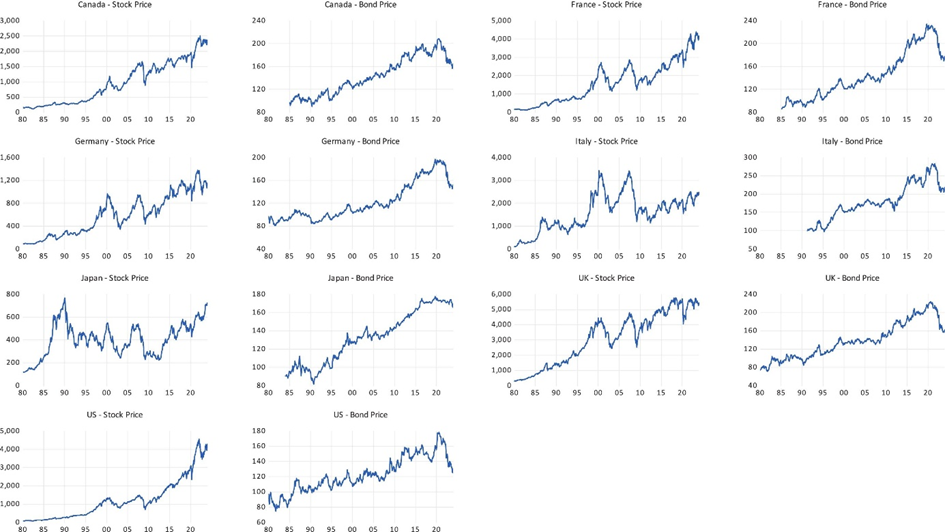
Whenever you look at a bond’s yield, I encourage you to ask one additional question: after inflation, is this return truly acceptable for you?
What Goes Up Must Come Down
Already in 1974, Tyrone Davis reminded us that what goes up must come down. This does not mean it stays down—but it does mean fluctuations are inevitable. Few asset classes demonstrate this more clearly than cryptocurrencies.
Crypto assets can appear to be a shortcut to wealth one day and a source of deep disappointment the next. One year ago, price forecasts for Bitcoin exceeded USD 100,000, while projections for Ethereum, Solana, XRP, and others reached even more ambitious levels percentage wise. Stablecoins added further fuel to the imagination. In reality, none of these projections materialized so far. All major cryptocurrencies delivered negative performance in 2025.
| 2025-03-01 | 2026-02-01 | Performance |
BTC/USD | 97123.79 | 88815.39 | -8.55% |
ETH/USD | 3451.325 | 3047.325 | -11.71% |
SOL/USD | 216.62 | 128.04 | -40.89% |
XLM/USD | 0.448434 | 0.208512 | -53.50% |
XRP/USD | 2.4529 | 1.8779 | -23.44% |
Based on Data from Bloomberg | |||
Does this mark another opportunity—or the beginning of the end? Each investor must decide for themselves. I personally believe the probability that cryptocurrencies remain part of the financial world is greater than 50%. What I do not believe is that anyone can reliably predict Bitcoin reaching millions or Solana trading above USD 2,000. Here, once again, risk awareness and diversification are essential. If you follow Warren Buffett’s principle of investing only in what you truly understand, crypto may not be for you. If you are curious, however, today may be a more sensible entry point than during periods of hype—provided you only invest what you can afford to lose.
And What About Precious Metals?
Here, I remain consistent. Emotions, whether excitement or fear, are dangerous companions in investing. Warren Buffett’s (yes, him again) advice to be fearful when others are greedy and greedy when others are fearful is especially relevant now. After a strong run, precious metals may be worth rebalancing, depending on your time horizon and tolerance for volatility.
Our long-standing clients, especially the gold and silver enthusiasts, have been rewarded for their patience. Gold, silver, and eventually platinum made meaningful contributions to portfolio performance. When an asset performs this well, the question is no longer whether it was right to hold it, but how to manage it going forward.
| 2025-03-01 | 2026-02-01 | Performance |
XAU/USD | 2657.9 | 4377.32 | 64.69% |
XAG/USD | 29.569 | 73.8838 | 149.87% |
XPT/USD | 924.64 | 2129.71 | 130.33% |
XPD/USD | 914.83 | 1643.28 | 79.63% |
Based on Data from Bloomberg | |||
Will precious metals continue to perform strongly? We believe the chances remain high, supported by elevated equity valuations, declining interest rates, and a structurally weaker U.S. dollar among others. As always, the right allocation depends on your personal situation, not on headlines.
Closing Thoughts: Calm Conviction in an Emotional World
If there is one lesson the past year has reinforced, it is this: equanimity matters more than excitement. Markets will continue to fluctuate, narratives will change, and emotions will be tested. Investors who remain disciplined, diversified, and internationally positioned are best placed to navigate what lies ahead. A strong Swiss foundation, thoughtful currency exposure, and a long-term mindset remain powerful tools—not only to protect wealth, but to allow it to grow sensibly over generations.