
The Swiss View: Navigating a World on Edge
As we enter the final quarter of the year, investors face ongoing insecurity in what to expect and how to position. Wars continue to shape the global security landscape, tensions between major governments show little sign of easing, and trade relationships are being redrawn. Moreover, the most current elections in Germany and France and the ongoing back and forth in England as well as the US midterms cause further insecurity for future political developments. Good thing there is Switzerland, representing a boring but secure island within this chaos.
Meanwhile, financial markets have largely looked past these risks. While most of the indices have experienced some headwind since late August, the US indices that are most allocated to the Artificial Intelligence (AI) theme have kept their strength and showing high valuations. Whether this AI euphoria will prove to be sustainable has yet to be determined.
History suggests that stretched valuations crossing a certain threshold are usually not sustainable, even if the technology is exciting. Looking at the bond market, the cracks in the system have become much more acknowledged with US government yields rising to levels last seen in 2002. If, when, how much, and where the markets will correct or crash, we leave for the doomsayers to discuss. Nevertheless, it is important to position for different scenarios and ensure to keep a certain level of safety while not stopping to be invested in general. Being picky when taking risks and managing these risks properly is of the essence.
Diverging Paths, Persistent Pressures
As mentioned, US markets are stretched not because the economy is doing badly but because there is another Fear of Missing Out (FOMO) built around Artificial Intelligence.
When looking under the surface, as we like to do, there are certain cracks that must be taken into consideration when positioning a portfolio. Especially in the US, the consumers keep spending, which is a good thing in general as domestic consumption is an important driver to the domestic economy. Having said that, the question is what consumption is based on. In the US, it is currently at the expense of the savings rate. People are driving down their savings to spend more or at least keep their spending going.
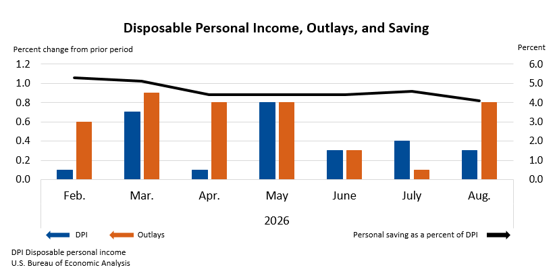
If inflation proves to be temporary based on the oil shock, we might be back at lower price levels as soon as the dispute in the middle east is ending, easing inflation, making the whole interest rate increase unnecessary. However, with the current trajectory hoping for a peaceful solution that ends the constraint of oil needs a lot of optimism.
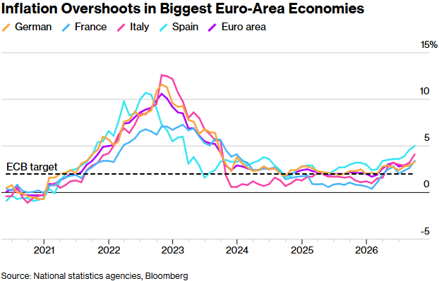
It is not only the US that shows some challenges with Diesel prices at all time highs. Also, Europe shows inflation rates that are well above the ECB target rates, justifying further interest increases over the next months. Spain on its side surprised with an inflation level of 5%, while Germany moves to 3.3%, last seen three years ago. Even in Switzerland, inflation surged to 1%.
In all of this challenging news, there is a silver lining which is the business activity accelerating not only in the US but also in Europe, leading to higher GDP growth than expected. Whether this uptick in business activity is sustainable is to be seen. If it proves to sustain, earnings could support further equity growth, leading to an ease in inflation and in government bond prices. However, if this uptick turns out to be short-lived, we expect investors to react accordingly, sending stocks further down to a more normalized level.
In general, compared to the US market, valuations at European markets are more reasonable priced. Even so the discount has narrowed since its low back in 2024, it is still significant. While discounts do not guarantee outperformance, they do provide a cushion that US equities currently lack.
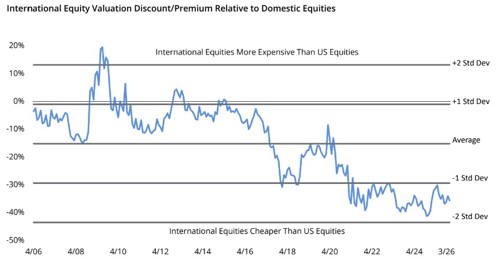
Source: Hartford Funds. International equity valuation discount/premium (S&P 500 vs MSCI World ex US Index).
The Return of the Term Premium
For years, people were told that bonds, especially government bonds are the safe part of the portfolio. That this is not necessarily true was made clear in 2022. Especially around government bonds, it is tricky as governments do not work like a company. However, if a conservative, safety seeking investor who put money with the government would find the same balance sheet and spending behavior in a company, they would take their money and run.
We currently find US government bonds yielding at levels last seen in 2002. While this might seem attractive at first glance, it is much more of warning sign as institutional investors show their worries about the US debt situation which surpassed USD 40 trillion in August and that inflation might be stickier than admitted by officials. Not for nothing, investors around the globe are following the bond market as its movement is often an indicator of what to expect in the markets. Also, in France, where government debt has reached unsustainable high levels, debt has become more expensive for the French government than it is for Italy.
Long story short, we stress the importance of taking into consideration the credibility of the issuer, the outlook for inflation, and the development of economic growth. Furthermore, given that bond prices fluctuate based on interest and inflation expectations, the maturity date must also be considered when making the decision on which bond to buy or even to make the decision whether to buy any fixed income investment.
USD Strength, an Opportunity
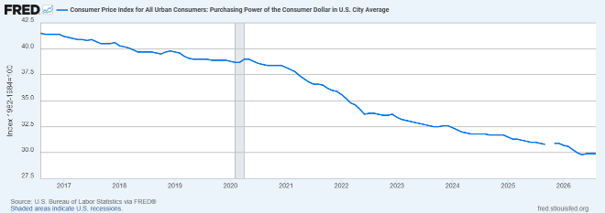
For US investors seeking international diversification, a stronger US dollar can create a challenge because foreign investments may translate into fewer dollars when the currency is strong. At the same time, however, a strong dollar can provide an opportunity to reconsider the allocation to foreign currencies and international markets. The important question is not simply whether the US dollar is strong against another currency. We also need to consider why it is strong and whether that strength is reflected in the currency's underlying purchasing power.
There can be substantial differences between short-term currency movements and long-term purchasing power. The US dollar may strengthen against other currencies for extended periods, while its purchasing power declines over a much longer time frame. One currency that has demonstrated remarkable long-term resilience is the Swiss franc. For this reason, we believe the current weakness of the Swiss franc can represent an opportunity for investors seeking long-term international currency diversification.
Of course, the current environment of higher oil prices could keep the US dollar stronger for longer. But if these pressures eventually ease, the longer-term forces affecting the dollar may become more visible again. It is also important to recognize that a weakening currency does not automatically make every foreign investment attractive. An investment still needs to generate a return that justifies the risks, including the potential impact of currency movements. When considering the long-term direction of a currency, we believe the fiscal discipline of the respective government is an important factor to watch. Governments that consistently spend beyond their means ultimately put pressure on the purchasing power of their currencies.
Gold Under Short-Term Pressure, Long-Term Case Intact
Gold has come under pressure. Rising government bond yields increase the opportunity cost of holding a non-yielding asset, and a strong US dollar makes gold more expensive for holders of other currencies.
We see this as a temporary headwind rather than a change in the underlying case. Both forces weighing on gold, high yields and a strong dollar, reflect conditions we consider unsustainable. If the dollar weakens and bond markets begin to question fiscal trajectories, gold's role as a store of value outside the financial system becomes more relevant, not less. Persistent central bank buying, continued geopolitical tension and sticky inflation add to that support.
Silver benefits from both monetary and industrial demand, particularly from solar and electronics, but it is more volatile and sensitive to the growth outlook. Platinum remains tied to industrial and automotive demand, and supply deficits can add to its attraction.
The Case for Diversification
Looking across asset classes, the message is consistent. US equities are expensive and concentrated, US government bonds carry growing fiscal risk, and the US dollar is strong in a way we doubt will last. Geopolitical tensions add an unpredictable layer on top.
This does not mean abandoning the United States, which remains home to many outstanding companies. It means that an over-reliance on US assets and on the US dollar is a risk many portfolios carry without having chosen it.
Our central recommendation is therefore unchanged: diversify internationally, beyond the US market and the US dollar. Spread exposure across regions, currencies and asset classes, including real assets such as gold, and keep a clear view of what you own and why.