
The Swiss View: The Price of Optimism
Autumn is settling over the Swiss Alps as the year enters its final stretch. Across the Atlantic, the US midterm elections have provided some political clarity, but they have also raised new questions about the direction of the American economy and its role in global geopolitics. In Europe, social unrest and political tensions continue to challenge stability, while the ongoing conflicts in Eastern Europe and the Middle East remain a source of uncertainty, not least because of their impact on energy prices and inflation.
Meanwhile, here in Switzerland, we have our own political excitement. We are closely following the question of who will succeed Federal Councillor Guy Parmelin and whether Switzerland might end up with two members of its seven-person Federal Council coming from the same village. These are the kinds of political concerns we Swiss occasionally allow ourselves to get worked up about.
All joking aside, Switzerland is not entirely immune to the tensions seen in other countries. We, too, have witnessed unrest. Nevertheless, our institutions continue to function, our political system encourages compromise, and stability remains deeply rooted in our culture. From an international perspective, this may appear rather boring. As wealth managers, however, we have learned to appreciate the value of boring.
From a Swiss vantage point that is neutral, observant, and focused on wealth preservation, these currents are best navigated through a disciplined, long-term approach rather than reactive decisions.
When Expectations Meet Reality
In our previous edition of The Swiss View, we questioned the valuations of companies associated with artificial intelligence (AI). Recent market developments suggest investors are beginning to share those concerns.
After reaching an all-time high on October 6, the Nasdaq 100 lost momentum. Technology-heavy indices have faced increasing pressure as investors question whether enormous AI investments, often financed through debt, will generate sufficient returns. On October 30, the Nasdaq dropped more than 2.8% in a single day amid concerns over AI-related cash burn following earnings from Amazon and Intel. But it wouldn’t be the worst day this year.
There is little doubt that AI will transform industries. However, a revolutionary technology does not automatically make every company associated with it an attractive investment.
This reassessment is not limited to America. The Nikkei 225 experienced notable pressure in October, declining roughly 5% for the month at one stage, as AI and semiconductor-related stocks came under selling pressure.
Nevertheless, Japan offers opportunities beyond technology. Its gradual transition from deflation toward inflation, combined with improvements in corporate governance, creates an interesting environment for selective investors.
Europe presents another perspective. Although economic challenges remain, European equities usually trade at more reasonable valuations than their US counterparts. Investments in infrastructure, energy independence, and digital resilience offer opportunities supported by tangible economic needs.
Inflation and the Illusion of Safety
While equity investors debate valuations, bond markets are sending an equally important message.
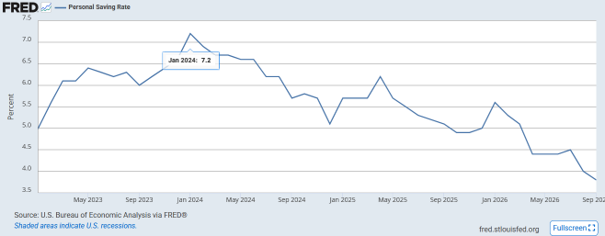
American consumers continue spending, supporting economic growth. However, the source of that spending deserves attention. According to the Bureau of Economic Analysis, the US personal saving rate declined from 4.0% in August to 3.8% in September, illustrating the trend of households supporting consumption by reducing their savings.
Meanwhile, inflation remains persistent in both the United States and Europe, mainly driven by energy costs. U.S 10-year Treasury yields have approached 5%, reflecting concerns about inflation, government borrowing, and future interest rates.
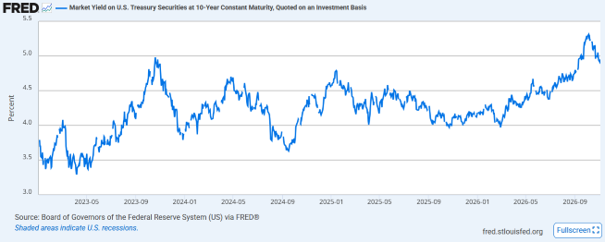
Will these high yields continue to offer actual safety if inflation remains persistent?
The last time inflation was consistently at or below 2% was 2020. The average inflation over the past 6 years for the U.S. has been right around 5% a year or roughly 30% cumulative.
So current safety in Treasury bills does not offer as much safety as some would hope; it is really offering a point of treading water for purchasing power for the American investor. This is especially true when considering what it could take to bring inflation in line with its target level of 2%.
According to Apollo Chief Economist Torsten Slok: “A macroeconomic model based on the historical relationship between interest rates, GDP and inflation suggests the Fed would need to raise the Fed funds rate by about 275 basis points, from roughly 4% today to 6.75% by the end of 2027, to bring CPI back to its 2% target. Inflation would not reach target until Q2, 2027, even with aggressive hikes.”
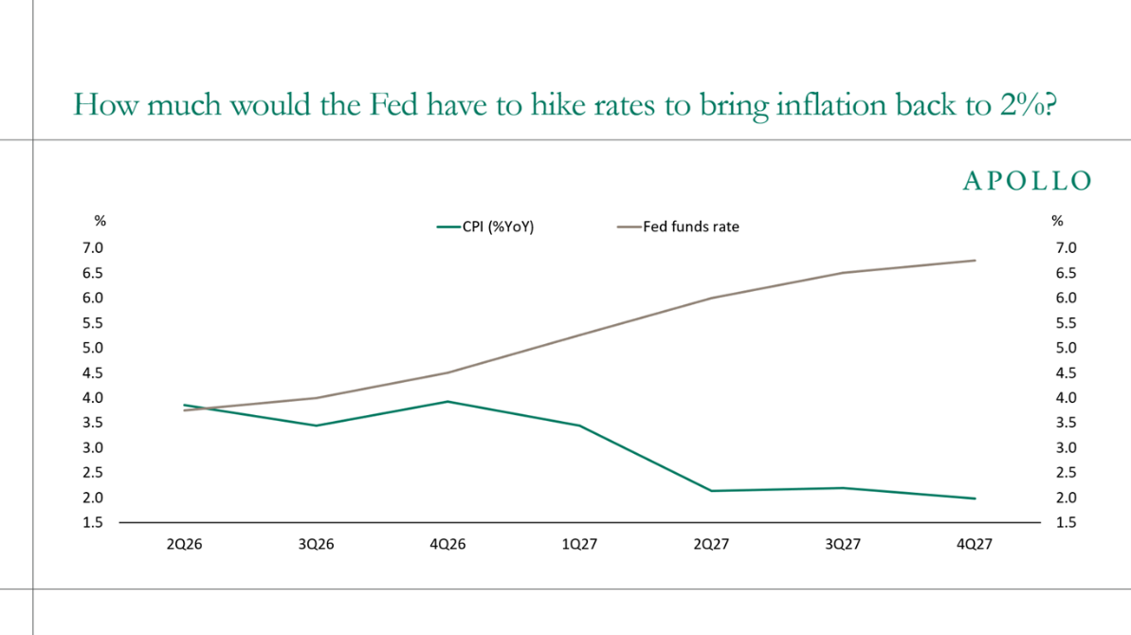
Sources: Bloomberg SHOK, Apollo Chief Economist
Switzerland stands out once again. Even with inflation around 1.5%, it remains within the Swiss National Bank's definition of price stability. Switzerland's comparatively disciplined fiscal and monetary policies have helped support confidence in the Swiss franc.
The lesson is simple: financial safety is not merely about getting your money back. It is about what that money will still buy.
The Price of Following the Crowd
The sharp market reaction following the landslide win by the democrats in the mid-term elections has exposed another vulnerability: concentration.
The Nasdaq and S&P 500 had their worst day since the tariff announcement in April 2025; the Nasdaq 100, since March of 2020. South Korea's tech-heavy market was down 8% at the open, triggering a circuit breaker halt in trading for 20 minutes. Japan's Nikkei 225 fell about 6%, heading towards bear territory (Bear Market: when a stock market index falls by 20% or more).
Simplified, tech and especially AI concentration in these markets is wreaking havoc on concentrated investors' three-year euphoria, and it may continue to do so. The European markets are faring better due to their strength in broader diversification.
Their semiconductor sector was hit similarly to the U.S. and Asia, but due to the stronger banks, healthcare, industrials, and energy sector alignment, it has allowed them to navigate the current run on tech.
For several years, investors concentrated in US technology stocks enjoyed exceptional returns. This success encouraged many to question the benefits of diversification.
Recent volatility offers a reminder that concentration works in both directions.
A portfolio heavily dependent on a handful of companies, one sector, or one country can suffer disproportionately when expectations change. International diversification helps address this risk by spreading investments across economies, industries, and currencies that do not always move together.
This is particularly important during periods of uncertainty. While diversification cannot prevent losses, combining investments with different economic drivers can reduce overall portfolio volatility and improve stability over time.
For us, this is not about predicting which market will outperform next year. It is about building portfolios that are less dependent on any single outcome. The objective is not to eliminate volatility but to make it more manageable without sacrificing the opportunity for long-term growth.
The US Dollar’s Strength Creates Opportunity
For many of our clients, the US dollar naturally dominates their financial lives. However, holding nearly all assets in one currency creates dependence on its long-term purchasing power.
Periods of dollar strength can offer opportunities to acquire international investments at more attractive exchange rates.
We continue to view the Swiss franc as an appealing currency for long-term wealth preservation. Its historical resilience reflects Switzerland's sound public finances, monetary discipline, and institutional stability.
The structural challenges facing the US dollar deserve attention. Persistent fiscal deficits, rising government debt, and efforts by some international investors to reduce dollar dependence raise legitimate questions about its long-term trajectory.
Precious Metals: Patience Remains Essential
Gold and silver have experienced renewed volatility. Gold briefly slipped below the psychologically important USD 4,000-per-ounce mark, while silver experienced even greater volatility, temporarily falling below USD 50 per ounce.
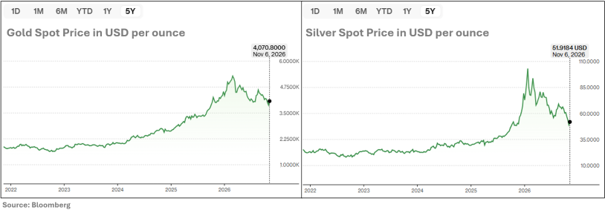
Higher bond yields and dollar strength have contributed to this pressure. When interest-bearing investments offer high returns, holding metals, which generate no income, becomes less appealing.
While the charts bring up memories of 2011, we believe that the long-term reasons for considering gold remain relevant.
Central-bank purchases, geopolitical uncertainty, rising government debt, and concerns about currency purchasing power continue to support its potential role as a store of value.
Neither metal is immune to further corrections. Yet appropriately sized precious-metal holdings can contribute to portfolio diversification because their performance drivers differ from those of traditional financial assets.
As always, valuation, allocation, and patience matter more than attempting to predict the next price movement.
Think in Generations, Not Market Cycles
Across financial markets, the message is consistent. Elevated valuations, persistent inflation, growing government debt, and geopolitical uncertainty make disciplined investing increasingly important.
Our Swiss perspective remains unchanged: invest in quality, pay attention to valuations, and diversify internationally across companies, sectors, regions, currencies, and asset classes.
International diversification is not a guarantee of higher returns. Its greatest benefit is reducing dependence on individual markets and economic developments.
Markets will experience corrections, political priorities will change, and new investment themes will emerge. Reacting emotionally to each development rarely serves long-term investors well. Therefore, equanimity continues to matter more than excitement.